 MOSSBACK STUDIO
Crate chance calculator
Type the rewards of a crate and their weights. You get the real chance of each reward, how many keys it takes to pull it, and a simulator to check that the crate feels right before players open it.
| Reward | Weight | Chance % | 1 in | Keys, 50% | Keys, 90% | Avg cost | |
|---|---|---|---|---|---|---|---|
| Total | 100 | ||||||
Change a weight and the chances follow. Type into "Chance %" instead and the weight of that row is set for you, the other rows keep their weights.
Try it: open the crate many times
Copy it into your config
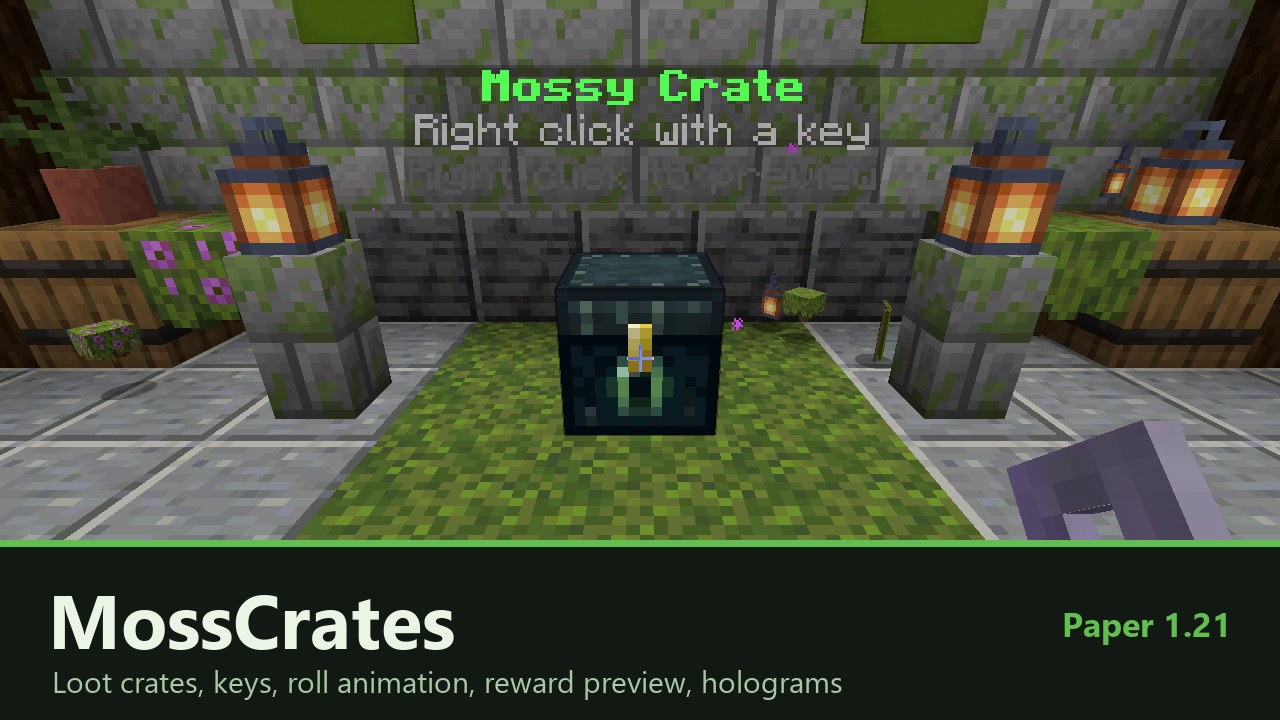
Need the crates too?
MossCrates puts a crate on any block: keys, a roll animation, a reward preview and holograms. One jar for Paper 1.21+, no other plugins needed. The MossCrates tab above gives you the rewards block ready to paste.
See MossCratesHow crate weights work
Almost every crate plugin picks a reward the same way: it adds up all the weights, then each reward gets its weight divided by that total. A reward with weight 5 in a crate whose weights add up to 100 has a 5% chance. The same weight 5 in a crate that adds up to 250 has a 2% chance.
chance = weight / sum of all weights
So weights do not have to add up to 100. It only makes them easier to read, because then every weight is its percent.
What "1 in 50" really means
A 2% reward is "1 in 50", but 50 keys do not guarantee it. After 50 opens a player has about a 64% chance to have pulled it at least once, and roughly one player in three is still waiting. That is why the table shows two more numbers: the keys needed for a 50% chance and for a 90% chance. If the 90% number is bigger than what a regular player will ever open, the reward is rarer than it looks.
Adding a reward changes all the others
Every new reward makes the total bigger, so all the old rewards get a little less likely. When you add a seasonal item to a crate, check the top reward again. If you want it to stay at exactly 1%, type 1 into its "Chance %" field after the change.
Plugins with rarity tiers
Some plugins roll twice: first a rarity (common, rare, legendary), then a reward inside that rarity. The chance of one reward is then the chance of its rarity times its share inside the rarity. Work out the tiers as one crate here, then each tier as its own crate, and multiply the two percentages.
Average cost
Put the price of one key into "Key price" and the last column shows what players spend on average for each pull of a reward. It is a quick way to see if the big prize is worth more or less than the keys it takes to get it.